
WHY INVEST IN LAOS
The Lao PDR Economy Continues To Be Experience Dynamic Growth And Resilience To Withstand Global Pressures, Largely Due To The Following Factors:
01
Political stability and strategic geographic advantage
02
Business-friendly policies and thriving ecosystems that have opened up opportunities for foreign and local investors
03
Large infrastructure investments
04
Efficient management of natural resources
ABOUT LAOS
Lao PDR is poised to boost competitiveness and emerge as a key economy in Southeast Asia, and transforming itself into one of the most dynamic countries in the region, offering diverse business opportunities to both domestic and foreign investors. becoming the preferred gateway to Asean markets


Land Area
236,800 km2

Capital
Vientiane Capital

Population
7,647,723 (2024)

Labor Force
3.57 Millions (2024)

Religion
Buddhism

Literacy
85%

Language
Lao

GDP Per Capital
1,970 US$ (2024)

Currency
Kip

GDP Growth
4.35 % (2024)
DRIVING A DYNAMIC AND RESILIENT ECONOMY
Lao PDR continues to demonstrate resilient, sustainable, and inclusive economic growth, steadily advancing toward its official graduation from Least Developed Country status in 2026. With GDP estimated at USD 15 billion in 2024 and growth reaching 4.35%, the country has successfully navigated the challenges of the COVID-19 pandemic, stabilizing its economy and reinforcing its position as one of Southeast Asia’s emerging markets. Lao PDR is a dynamic economy with outstanding progress in infrastructure development, energy exports, and regional connectivity, laying the foundation for long-term competitiveness.
Its resilience and increasing competitive environment have created attractive investing opportunities. Sound planning underpins Lao PDR’s economic growth. Short, medium and long-term planning are key elements of this, with the 10th National Socio-Economic Development Plan (NSEDP) 2026-2030 guiding policy priorities across government in line with the country’s economic and development transformation targets.
Meanwhile, diversification is supported by investment flows into various sectors and contributions to GDP are becoming increasingly service driven. Between 2021 to 2025, the services sector contributed 36.6% of GDP, outpacing the growth of industry at 32.5% and agriculture at 19.4%.
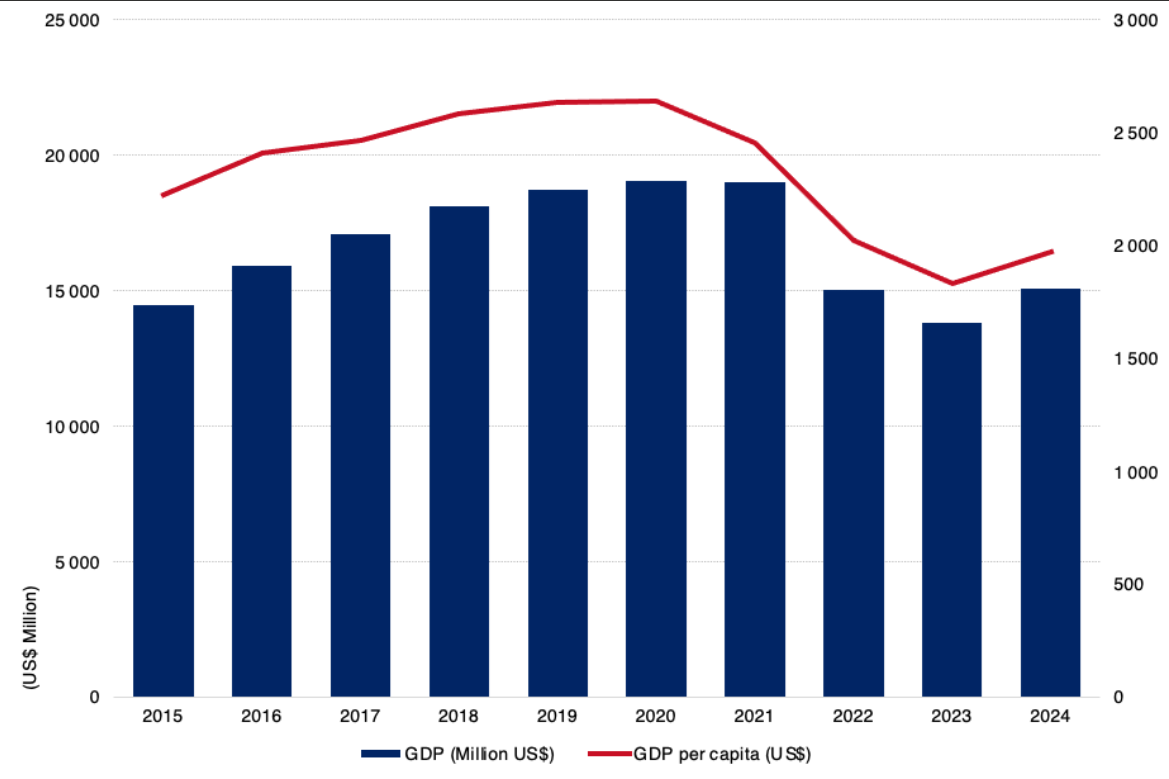
Data source: Lao Statistic Bureau (https://laosis.lsb.gov.la/)
The Lao PDR Economy Continues To Be Experience Dynamic Growth
Resilience To Withstand Global Pressures, Largely Due To The Following Factors:
- Strong governance and transparency framework with enhanced sectorial cooperation.
- Business-friendly policies and thriving ecosystems that have opened up opportunities for foreign and local investors.
- Large infrastructure investments.
- Efficient management of natural resources.
Shaping a Trade and Investment Destination of Choice
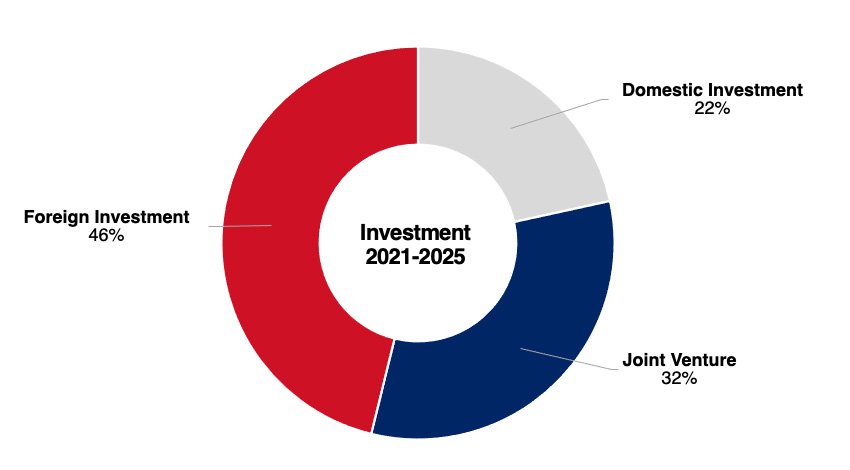
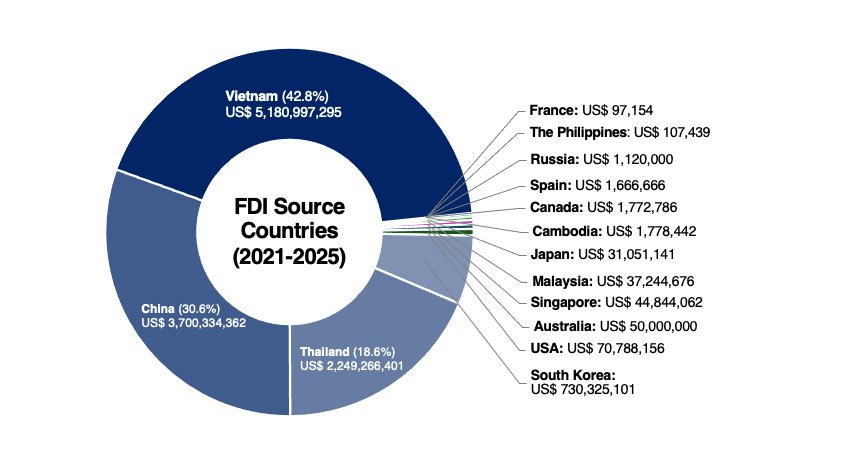
Lao PDR has met the criteria for graduation from Least Developed Country (LDC) status and is currently in the transition period leading to its official graduation from the LDC list in 2026. The 10-year strategy (2026–2035) sets the goal of transforming Lao PDR into an upper-middle-income country by 2035, with Gross National Income (GNI) per capita reaching USD 5,300. The strategy also aims to achieve an annual Gross Domestic Product (GDP) growth rate of 6–7%. At the same time, Lao PDR seeks to increase Foreign Direct Investment (FDI) in priority sectors with strong potential, guided by the principles of selectivity, quality, and sustainability. This will be supported through comprehensive improvements to the investment environment and business climate.
Foreign Investment (Controlled Business and Concession) in Lao PDR by Source Country (2021-2025)
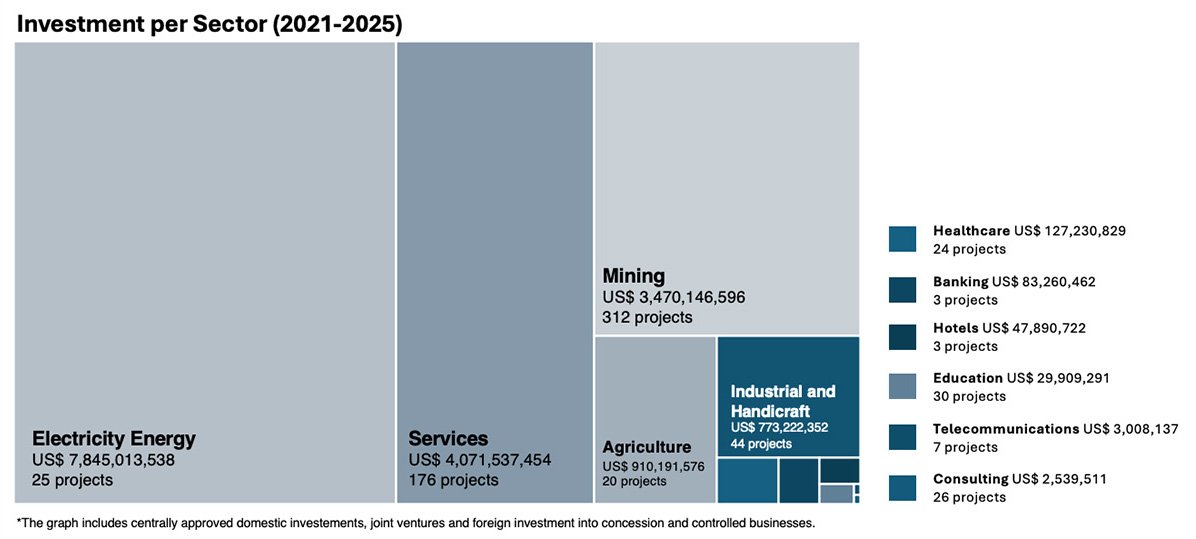
Investment by Sectors 2021-2025
Strengthening Reforms in Governance and Transparency
The Government of Lao PDR has committed to improving the business environment by streamlining procedures, reducing time and costs, and enhancing transparency and efficiency in the issuance of business and investment licenses. The reform efforts were reflected in the implementation of the Prime Minister’s Order No. 002/PM, dated 01 February 2018, on improving regulations and coordinating mechanisms to enhance the Ease of Doing Business in Lao PDR. Key achievements under this reform include the reduction of the enterprise registration process to two steps, the digitalization of enterprise registration, and the modernization of the online tax payment system. In addition, investment promotion and management under the Investment Promotion and Management Committee (IPMC) have been streamlined, reducing the investment approval process from 10 steps to just 4.
Furthermore, several important laws and regulations have been introduced and revised to provide clearer provisions and institutionalized mechanisms, ensuring consistency and alignment across ministries and local governments, such as: Law on Investment Promotion (2024), Law on Vehicles (2021), Law on Judgement Enforcement (2021), Law on Enterprises (2022), and Law on Rehabilitation and Bankruptcy of Enterprises (2019).
In 2025, the government undertook a major organizational restructuring to become more compact, streamlined, and efficient, reducing the number of ministries from 17 to 13. The Ministry of Planning and Investment was integrated into the Ministry of Finance, while the Ministry of Energy and Mines merged with the Ministry of Industry and Commerce. Likewise, the Ministry of Natural Resources and Environment combined with the Ministry of Agriculture and Forestry to form the Ministry of Agriculture and Environment. The Ministry of Home Affairs was dissolved, with its responsibilities distributed among various entities. Meanwhile, the Ministry of Information, Culture, and Tourism was restructured: its information sector was transferred to the Party Central Committee’s Propaganda and Training Board, and the ministry was renamed the Ministry of Culture and Tourism.
Investment Incentives
The Law on Investment Promotion (2024) offers a comprehensive incentive framework to attract quality investments aligned with the national socio-economic development plan along a green and sustainable pathway, combining sector‑based with zone‑based incentives in strategic areas. Incentives include profit tax holidays, income tax reductions for experts, customs duty and VAT exemptions, and preferential land lease rates. Additional facilitation measures include supporting foreign investors along with their family members, foreign specialists, or experts to obtain residence permits and multiple-entry business visa.
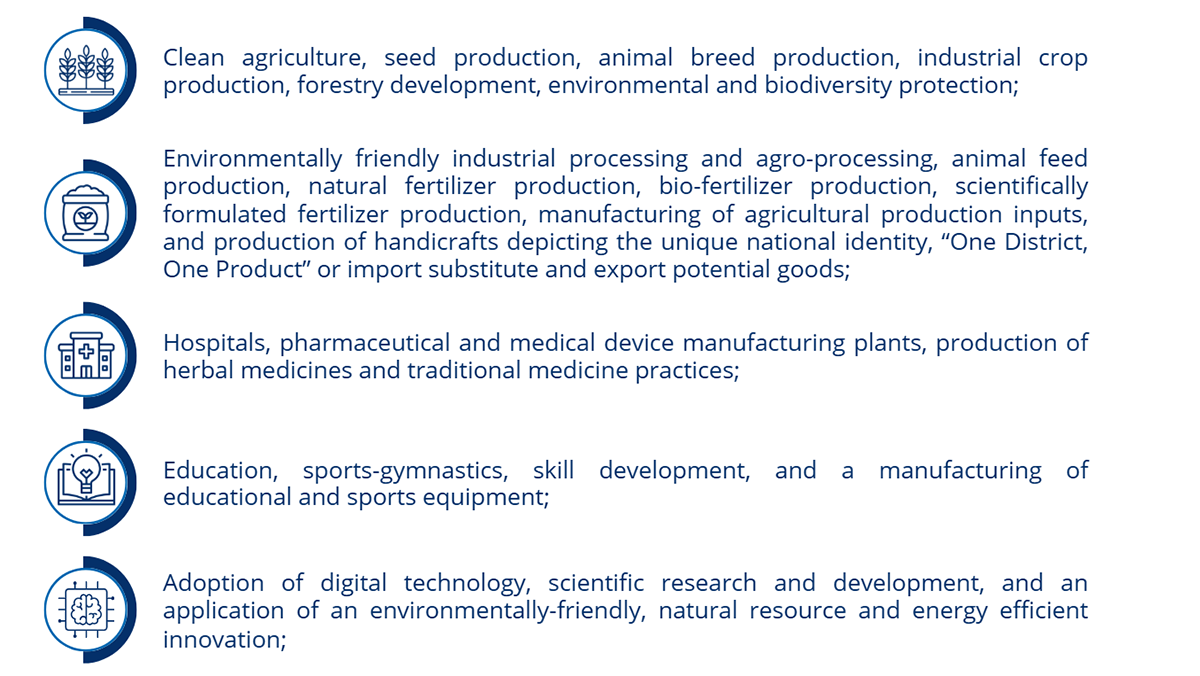
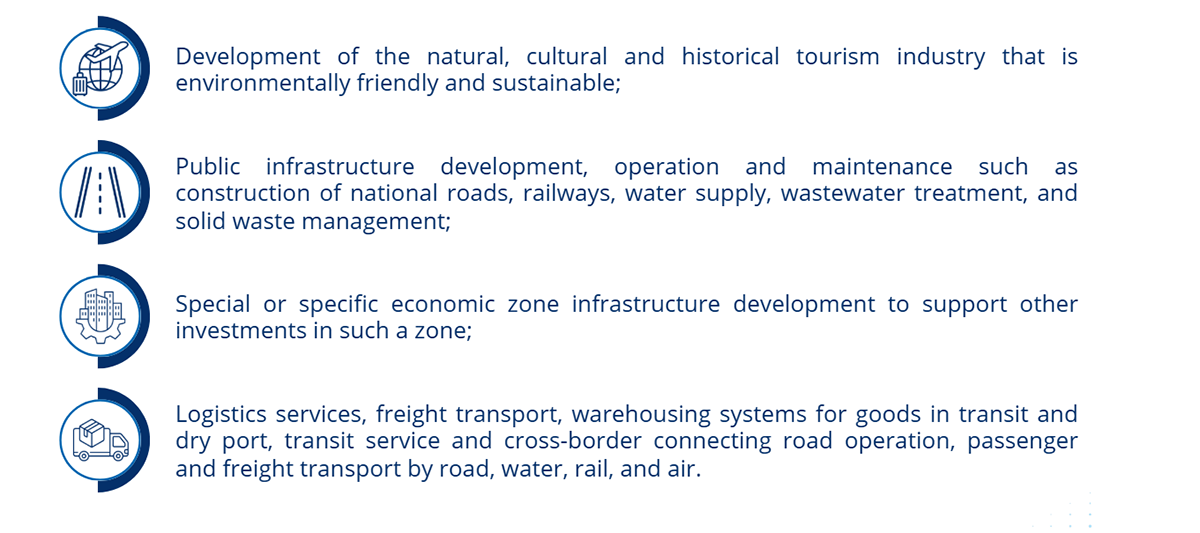
Sectors Eligible for Incentives
Incentives on Profit Tax and Land Use
|
Zones |
Profit Tax |
Rental or Concession Fee Exemption |
||
|
Exemption Period |
Additional Exemption Period (Activities in Article 9 (1), (2), and (3) of Law on Investment Promotion) |
Exemption Period |
Additional Exemption Period (Activities in Article 9 (1, 2, 3 and 4) of Law on Investment Promotion) |
|
|
Zone 1 where socio-economic infrastructures do not facilitate investments |
10 years |
5 years |
10 years |
5 years |
|
Zone 2 where socio-economic infrastructures facilitate investments |
4 years |
3 years |
5 years |
3 years |
Remark: Education sector shall enjoy a profit tax exemption throughout the entire investment period.
Incentive on Custom Duty, Income Tax and Value-Added Tax
- The importation of materials not available domestically, to be used in creating fixed assets as well as machinery and vehicles that are directly applied in connection with the manufacturing processes is to enjoy a customs duty exemption.
- An importation of raw materials, minerals, materials, equipment, and spare parts to be used in manufacturing for exports shall enjoy a custom duty exemption.
- The importation of raw materials, minerals, materials, equipment, and spare parts to be used in manufacturing for import substitutes for domestic distribution shall enjoy a custom duty exemption.
- An exportation of produced, cultivated or raised agricultural products, ready-made industrial goods which have gone through manufacturing or development processes, handicraft products shall enjoy a customs export duty exemption,
- Specialists working in promoted sectors shall enjoy a personal income tax incentive at a rate of five percent (5%).
- Value-added tax incentives shall observe the Law on Value-Added Tax
Accelerating Growth via Special Economic Zones
Lao PDR has established 21 Special Economic Zones (SEZs) to create new opportunities and drive stronger growth. SEZs play a vital role in driving economic growth by creating clusters of new and emerging industries, fostering innovation, and stimulating consumption in line with globalization and regional integration. They serve as magnets for both local and foreign direct investment, while establishing robust infrastructure networks that support operations and facilitate exports. In addition, SEZs strengthen supply chain linkages and provide access to neighboring markets, all while focusing on the development of talent to sustain and enhance business competitiveness.
Since the introduction of the first SEZ in 2003 to 2025, the SEZs have brought in investments of up to US$41.7 billion, contributed US$78,831,322 in government revenue and increased the value of exports by US$3.97 billion. As of 2025, there were almost 1999 foreign and domestic companies registered in the SEZs nationwide. Majority are from China (1312 businesses), Thailand (73), Malaysia (47) and Japan (41), representing companies like Essilor, Nikon, and ISUZU among others.
The government has set up One-Stop-Service (OSS) within SEZs to provide on-site approvals of permits and licenses as well as facilitate other investment procedures.
Key service offerings at OSS Centers:
- Address investor queries and assist in identifying the best investment platform.
- Provide latest information on promotions, policy, and regulatory changes.
- Issue enterprise registration certificate, land use right lease license, import-export certificate, and tax payment.
- Facilitate the permit and certificate related to labor management, construction, and environmental assessment.
- Fast-track application processes and facilitate business-related barriers.
- Centralized comprehensive information on incentives and tax reforms; and
- Provide aftercare services.

Leveraging on Distinct Advantages
Lao PDR’s engine of growth continues to be powered by its abundant natural resources, with agriculture, minerals, hydropower-based electricity, and tourism remaining the country’s key pillars.
| Sector | Details |
| Energy | With an aim to unlock energy potential, the country is now more closely integrated into the ASEAN Power Grid (APG), a regional initiative to link electricity systems across all ten ASEAN member states. This enhances energy security, supports renewable energy use, and strengthens economic integration. While hydropower remains the backbone, Lao PDR is exploring solar, wind, and biomass to diversify supply. Lao PDR continues to see the emerging opportunities in energy. Between 2021 and 2025, the country generated a total of 251,052 million kWh of electricity, of which 195,602 million kWh was exported to regional markets. |
| Agriculture | The agriculture sector in Lao PDR continues to play a vital role in national development. Guided by the Agriculture Development Strategy to 2025 and Vision 2030, the country is advancing toward modern, resilient, and sustainable farming practices. Progress is evident across crop production, livestock, forestry, and fisheries, while efforts to ensure food security, promote clean agriculture, and expand competitive exports are strengthening Laos’ position in the regional market. |
| Manufacturing | Laos’ manufacturing sector has become one of the key pillars of the economy, contributing significantly to GDP growth alongside services and agriculture. Expansion in food processing, garments, construction materials, and light industry has been driven by regional demand and foreign investment, while reforms and infrastructure improvements have strengthened competitiveness. Aims to be a manufacturing base given its proximity to other countries and low production cost Promote the setting up of manufacturing bases at SEZs that have attractive incentives |
| Tourism | The tourism sector is experiencing a strong rebound, welcoming over 12.5 million international visitors during 2022-2025. The government is promoting sustainable tourism, infrastructure upgrades, and workforce training to strengthen its position as a green, cultural destination in ASEAN. |
Shaping inclusive and sustainable growth
- Lao PDR is also creating future-oriented education and training programmes that will ensure young people are equipped with the right skill sets and knowledge to support growth, seize opportunities in the job market and reduce poverty.
- In driving the country’s socio-economic transformation agenda, it has already achieved poverty-related Millennium Development Goals (MDG) by halving its poverty rate by 2015.
- Recognizing the importance of building a solid foundation for future generations, Lao PDR has also undertaken the Health Sector Strategy 2020, National Nutrition Strategy (2015 – 2023) and Plan of Action (2016 – 2020) to improve healthcare, and is gearing up to implement universal health coverage with support from development partners.
Regional Integration
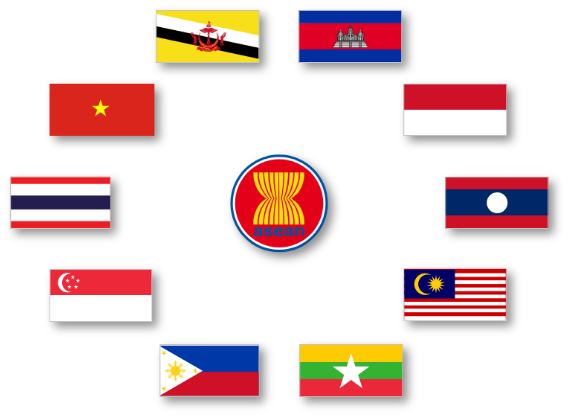
Poised to emerge as a key economy in the region, Lao PDR offers diverse business opportunities to both domestic and foreign investors alike. Bordering key markets – Thailand, China, Vietnam, Cambodia and Myanmar – this land-linked country is at the heart of ASE AN, with strong bilateral trade and investment ties with key economies in the region and beyond, leveraging on the establishment of the ASEAN Economic Committee (AEC), as well as ASEAN’s trade and investment partners. In addition to being a member of the World Trade Organization (WTO) since 2013, it also has bilateral investment treaties with 26 nations, and General Special Preferences (GSP) privileges with 48 countries.
I. AT THE HEART OF REGIONAL INTEGRATION
Lao PDR is at the heart of ASEAN, one of the most dynamic regions in the world. It has strong bilateral trade and investment ties with key economies in the region and beyond, leveraging on the establishment of the ASEAN Economic Committee (AEC), as well as ASEAN’s trade and investment partners.
Lao PDR has the strategic geographic advantage of being land-linked, bordering key ASEAN markets including Thailand, Vietnam, Cambodia, and Myanmar. It also borders China in the north and is a key node in the One Belt, One Road Initiative.
II. ASEAN Regional Integration: Regional investment Promotional Action Plan (RIPAP)
On 7 October 2024, RIPAP was launched during the 2nd ASEAN Investment Forum in Vientiane. This strategic initiative was developed in collaboration with the Coordinating Committee on Investment (CCI), ASEAN Secretariat, and the United Nations Economic and Social Commission for Asia and the Pacific (ESCAP). As part of RIPAP, ASEAN countries are working together to promote the region as a unified investment destination while highlighting each member state’s unique strengths across different stages of industry value chains. RIPAP targets high-potential sectors including.
- Biofuels
- Solar PV equipment
- Carbon capture and storage (CCS)
- Medical devices
- Veterinary healthcare
- Smart grid development
- Sustainable building materials
The plan is being implemented in phases from 2025-2030, with participating IPAs working together on coordinated investor outreach, joint participation in international events, and development of investment-ready projects. Through sector-specific working groups, ASEAN IPAs are developing marketing materials, engaging with industry associations, and showcasing concrete investment opportunities at major international trade fairs and on the InvestASEAN platform.
For Lao PDR, RIPAP offers an opportunity to attract investment in specific value-chain activities where the country has natural advantages. By participating in this regional framework, Lao PDR benefits from collective ASEAN branding and joint marketing efforts while positioning itself strategically within broader regional supply chains.